

Are The English Heritage Makeup Tutorials Accurate?
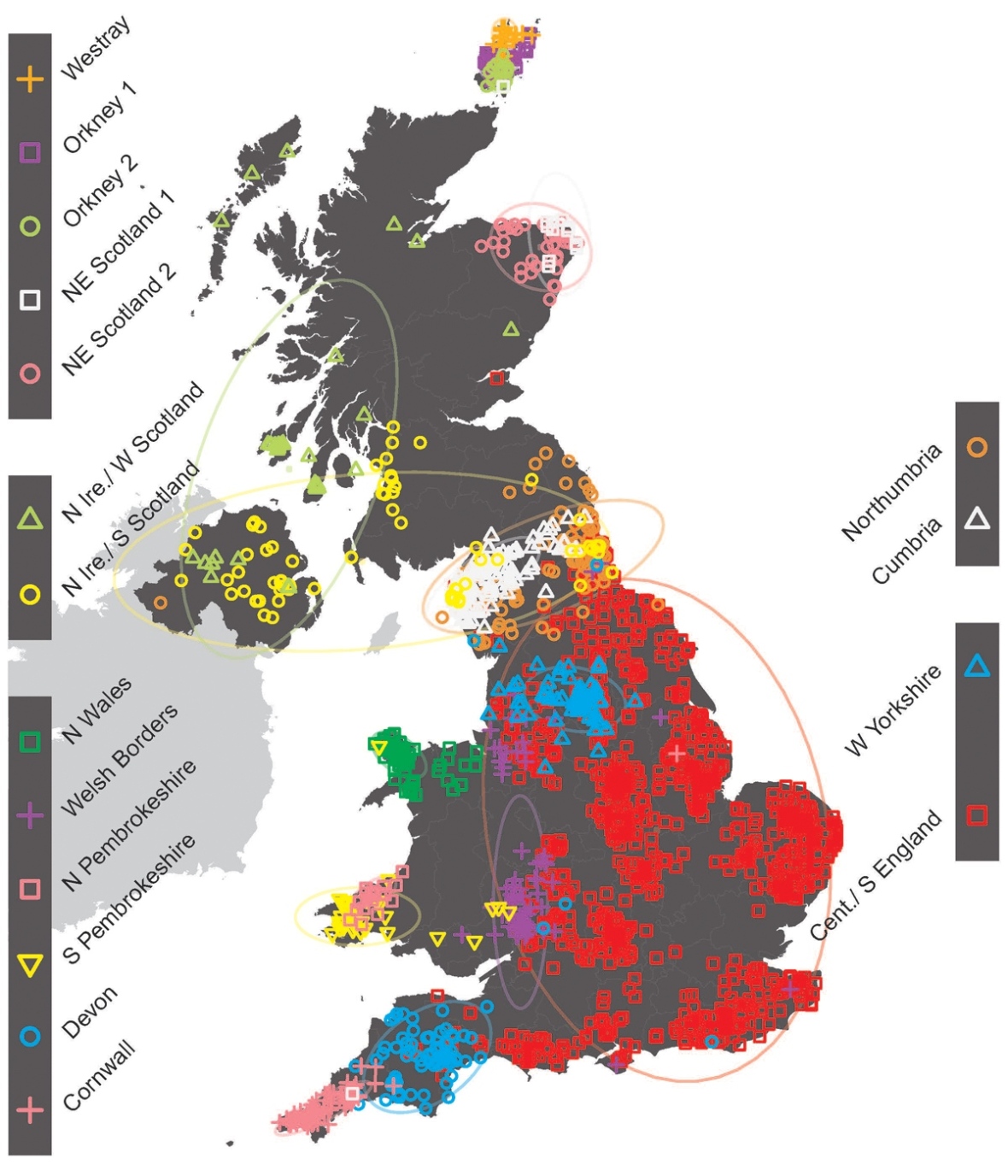
Britons are notwithstanding living in the same 'tribes' that they did in the 7th Century, Oxford University has found after an astonishing study into our genetic make-up. Archaeologists and geneticists were amazed to observe that genetically similar individuals inhabit the same areas they did following the Anglo-Saxon invasion, following the autumn of the Roman Empire.
In fact, a map showing tribes of Uk in 600AD is almost identical to a new chart showing genetic variability throughout the UK, suggesting that local communities accept stayed put for the past 1415 years.
Many people in United kingdom claim to feel a stiff sense of regional identityand scientists say they the new study proves that the link to birthplace is Deoxyribonucleic acid deep.
The almost striking genetic separate can exist seen between people living in Cornwall and Devon, where the division lies exactly forth the county border. It means that people living on either side of the River Tamar, which separates the ii counties, have dissimilar DNA.
Similarly at that place is a big area in southern and central England with a shared genetic heritage which coincides with the boundaries of Anglo-Saxon England. Besides, dissever genetic groups can be found in areas of Due north and Southward Wales corresponding to the ancient kingdoms of Gwynedd and Dyfed.
In the Due north, specific groups were found in the North E, tallying with the surface area of Bernicia which was colonised past the Angles from Southern Denmark. And, intriguingly, a small-scale genetic cluster was spotted in the West Riding of Yorkshire, which coincides with the former small-scale kingdom of Elmet, one of the last strongholds of the ancient Britons.
Geneticist Professor Sir Walter Bodmer of Oxford University said: "What it shows is the extraordinary stability of the British population. Britain hasn't changed much since 600AD.
"When nosotros plotted the genetics on a map we got this fantastic parallel betwixt areas and genetic similarity.
"It was an extraordinary effect, 1 which was much more than I expected. We see areas like Devon and Cornwall where the divergence lies straight on the purlieus."
Professor Mark Robinson, of Oxford University's department of archæology added: "The genetic make-up we encounter is really one of maybe 1400 years ago."
The 'People of the British Isles' study analysed the Deoxyribonucleic acid of 2,039 people from rural areas of the Uk, whose four grandparents were all born within 80km of each other.
Because a quarter of our genome comes from each of our grandparents, the researchers were effectively sampling Deoxyribonucleic acid from these ancestors, assuasive a snapshot of UK genetics in the late 19th Century before mass migration events caused past the industrial revolution.
They then analysed DNA differences at over 500,000 positions within the genome and plotted each person onto a map of the British Isles, using the centre point of their grandparents' nascency places, they were able to encounter how this distribution correlated with their genetic groupings.
Professor Peter Donnelly, Director of the Welcome Trust Heart for Human Genetics said: "It has long been known that human populations differ genetically but never before accept we been able to observe such exquisite and fascinating detail.
"We used the genetic fabric to really tease apart the subtle differences in Dna. And nosotros're able to zoom in and see which areas are closer genetically.
"In a certain sense there are more than genetic differences between North and Due south Wales than between Kent and Scotland.
"And in a certain sense there is more similarity betwixt people in the North of England and Scotland than people in the southward of England."
The findings also showed that in that location is not a unmarried 'Celtic' genetic group. In fact the Celtic parts of the Great britain (Scotland, Northern Ireland, Wales and Cornwall) are amidst the most different from each other genetically.
And the enquiry has finally answered the question of whether the Romans, Vikings and Anglo-Saxons interbred with the Brits or wiped out communities.
The team found that people in cardinal and southern England accept a meaning DNA contribution from the Anglo-Saxons showing that the invaders intermarried with, rather than replaced, the existing population.
But there is no genetic signature from the Danish Vikings even though they controlled big parts of England – The Danelaw – from the 9th century, suggesting they conquered, kept largely to themselves, and then left. Just Orkney residents were constitute to have Viking Deoxyribonucleic acid.
"We found that 25 per cent of the DNA of someone living in Orkney is from Norse ancestry which suggests that when the Vikings arrived the intermingled with the local population rather than wiping them out," added Prof Peter Donnelly.
"Similarly the Saxons in Germany take contributed Deoxyribonucleic acid to some of the English groups but non to some of the others. We can encounter not only the differences in the UK just the reasons for those differences in terms of population movements."
http://www.ox.air conditioning.united kingdom/news/2015-03-19-who-do-y'all-retrieve-you lot-actually-are-genetic-map-british-isles#
https://countryofnowhere.wordpress.com/2016/05/20/simple-uk-genetic-maps/
Source: https://countryofnowhere.wordpress.com/2016/05/11/inbreeding-in-the-uk/
Posted by: schmidtroomens89.blogspot.com
0 Response to "Are The English Heritage Makeup Tutorials Accurate?"
Post a Comment